

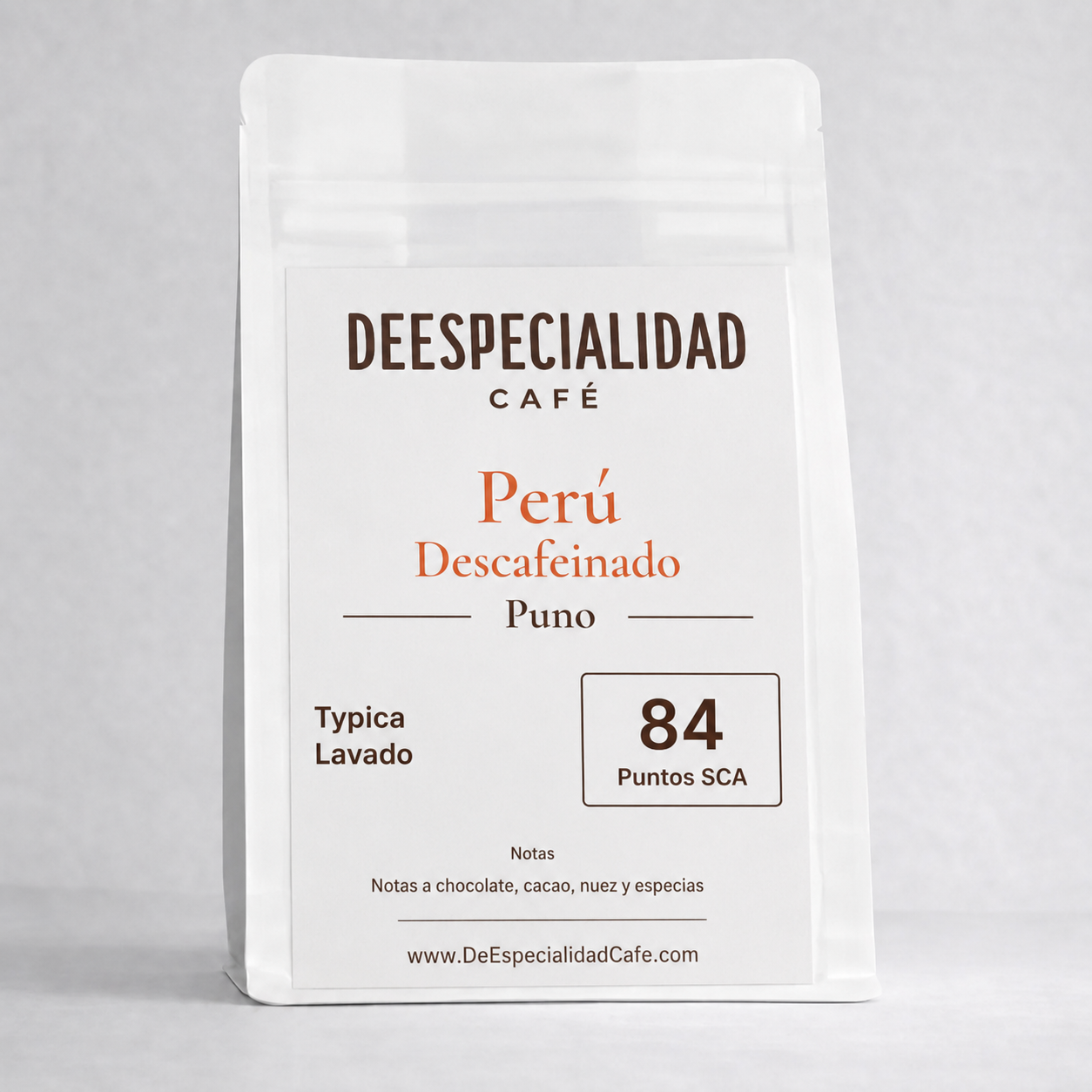
Perú Descafeinado
Perú Descafeinado
Café con fragancia y base de chocolate, notas de cacao, nuez y especias, de perfil dulce y achocolatado
Couldn't load pickup availability
Share
Coffee information
Café de fragancia y marcada base de chocolate, con agradables notas de cacao, nuez y especias. En taza ofrece un perfil dulce y achocolatado, con cuerpo medio y acidez baja, dando lugar a un conjunto equilibrado, suave y agradable. Se trata además de un café descafeinado mediante un proceso con agua, diseñado para retirar la cafeína conservando los demás compuestos solubles responsables del sabor

Origin
About this coffee
Puno
Este café nace en Puno, Perú, concretamente en el valle de Alto Inambari, provincia de Sandia, a partir de pequeñas fincas situadas entre los 1.850 y 2.100 metros de altitud. Es producido por alrededor de 25 pequeños caficultores que trabajan en parcelas familiares mediante sistemas agroforestales, donde la variedad Typica crece bajo la sombra de árboles nativos, favoreciendo la conservación de la biodiversidad y el equilibrio del ecosistema. La organización de los productores facilita el trabajo conjunto durante la cosecha y la postcosecha, contribuyendo a mejorar la consistencia, la trazabilidad y el control de calidad de los lotes. La recolección se realiza manualmente, seleccionando las cerezas en su punto óptimo de maduración, y posteriormente el café se procesa mediante el método lavado.
Frequently asked questions
What grind should I choose?
Each coffee maker needs a different grind. These are the available options:
- Whole Bean — If you have a grinder at home and prefer to grind just before brewing.
- Espresso — For espresso machines with a portafilter, under pressure.
- Filter — For drip coffee makers, V60, Chemex, or Melitta.
- Moka — For Moka pots (the classic stovetop one).
- French Press — For plunger coffee makers.
- Aeropress — For the Aeropress method.
- Cold Brew — Coarse grind for cold brew coffee.
- Naked Portafilter — For bottomless portafilters on espresso machines.
I'm just starting out, what coffee can I choose?
If it's your first time buying specialty coffee, we recommend starting with balanced and easy-to-drink coffees.
To start
Latin American coffees are usually a safe bet, with soft and balanced flavors. Origins such as Brazil and Colombia are ideal to start with.
When you want to try something different
You can explore coffees with processes such as natural or honey, which usually have more fruity or intense profiles. For example, Ethiopia.
How many cups do 250g and 1kg make?
Using about 10g per cup as a reference: 250g yields approximately 25 cups and 1kg yields about 100 cups. This may vary depending on the brewing method and the intensity you prefer.
When is coffee roasted and how do I store it?
We roast daily so that you always receive it as fresh as possible.
You can store it in the same bag you receive it in — it has a degassing valve. Store it in a cool, dry, and dark place.
To enjoy it at its best: ground, consume within 2–4 weeks; whole bean, it stays fresh for up to 6–8 weeks.
Is it very acidic? Is it 100% Arabica?
Regarding acidity: Nothing like commercial coffee. No burnt or harsh flavors. The acidity is like that of a ripe fruit — it brings freshness and complexity.
Regarding origin: Yes, all our coffees are 100% specialty Arabica, selected for their quality and cup profile.
Why is your coffee cheaper than other specialty coffees?
Our goal is to make specialty coffee accessible to more people.
We work with tight margins and optimize our processes to offer high-quality coffee at a lower price than many brands in the industry, without compromising on bean quality or roast.
